Emerson ecologicsreplatform
About
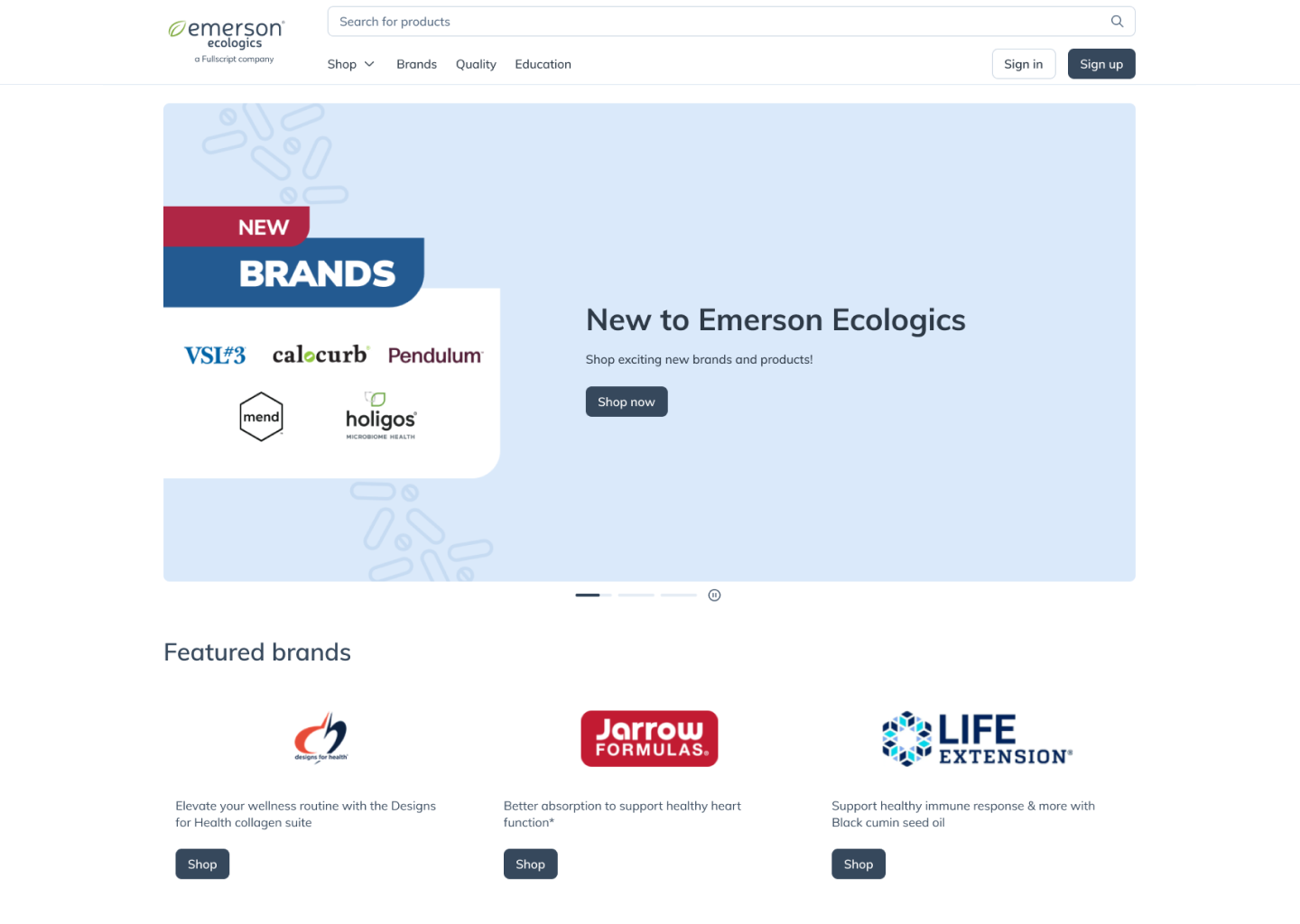
Following Fullscript's 2022 acquisition of Emerson Ecologics, a $220M wholesale supplement platform with ~25,000 monthly ordering accounts and a costly legacy platform with a different tech stack. Project Lighthouse rebuilt Emerson from scratch on the Fullscript stack. The guiding principle: lift and shift with revenue continuity. Do no harm to a thriving business while laying the groundwork for future growth.
The problem
Emerson ecologics customer base was loyal, established, and resistant to change. Moving those practitioners to an entire new platform under Fullscript was too risky and could cause a significant churn.Beyond user risk, the legacy platform was running on borrowed time. Significant downtime during important events like Cyber monday, accumulated tech debt, security vulnerabilities, and zero product analytics. Emerson and Fullscript were also running redundant contracts for taxes, email, payments, and catalog management — expensive and operationally siloed.
My role
I was the only designer embedded in the Lighthouse team for the entire project. With 50+ projects done during the replatform, often four running concurrently, I owned design end-to-end for 35+ of them, covering every major surface of the platform: homepage, catalog & search, product detail, cart, checkout, order history, reordering, account and so on.Working alongside two tech leads and eighteen developers, I advocated for EE-specific UX needs and at same time promoting improvements for both Emerson platform and Fullscript to critical areas like order history, checkout and so on.
guiding principle
Lift and shift with revenue continuity. Do no harm to a thriving $220M business, while laying the foundation for future growth, including moving wholesale-only practitioners toward Fullscript's higher-margin Direct-to-Patient model.
process
User flows & sitemap
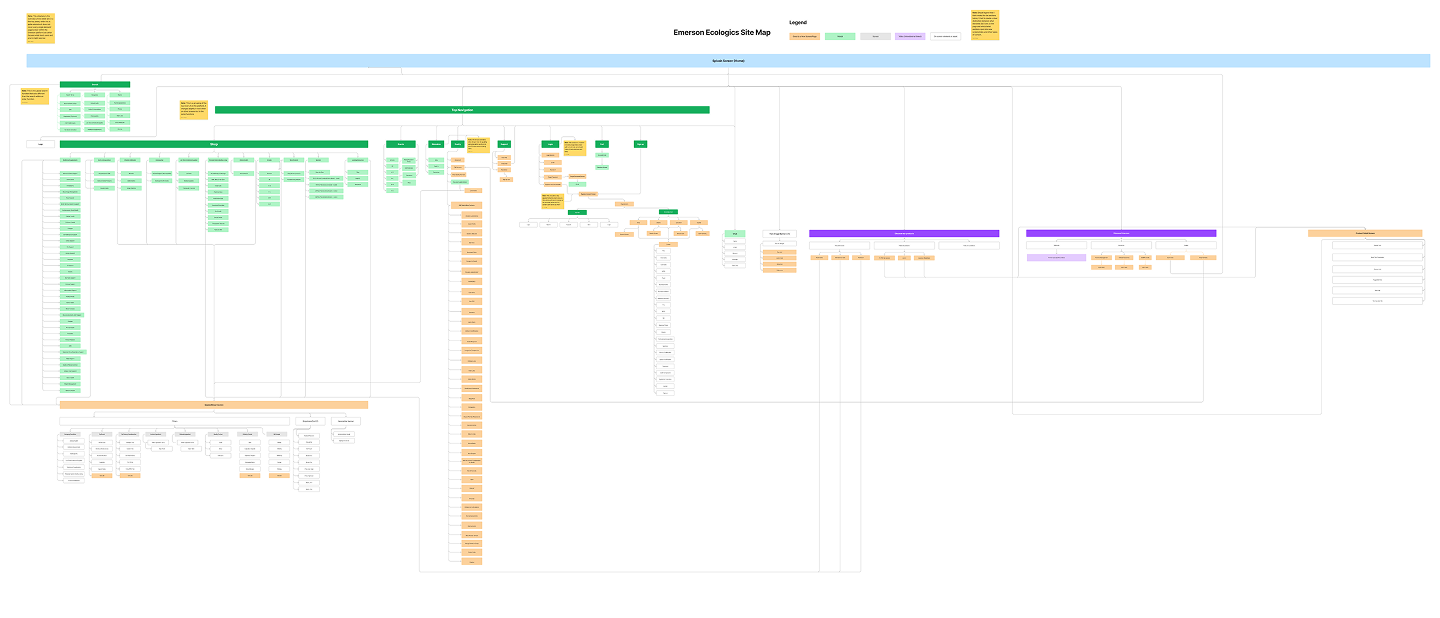
Before any UI, the full scope was mapped of the existing platform into a sitemap. The team's shared reference for what needed to be built, what could be removed, and where design decisions were required. Then we documented every key practitioner journey to make sure no existing workflow would be broken in the migration.
Workflow plan
At this scale, close collaboration with the Product Manager and Tech Leads was essential. Together, we broke the project into 3 structured phases and 50+ parallel sub-projects across Back-end, Front-end, and Core teams (18+ developers total) keeping dependencies manageable and allowing teams to move simultaneously without blocking one another.
Design process
Rebuilding Emerson meant working within Fullscript's existing design system while solving for a distinct set of user needs. The challenge wasn't just modernizing an outdated experience, it was doing so without disrupting the workflows users already knew and depended on. This involved both adapting existing components and designing new ones purpose-built for Emerson's use cases.
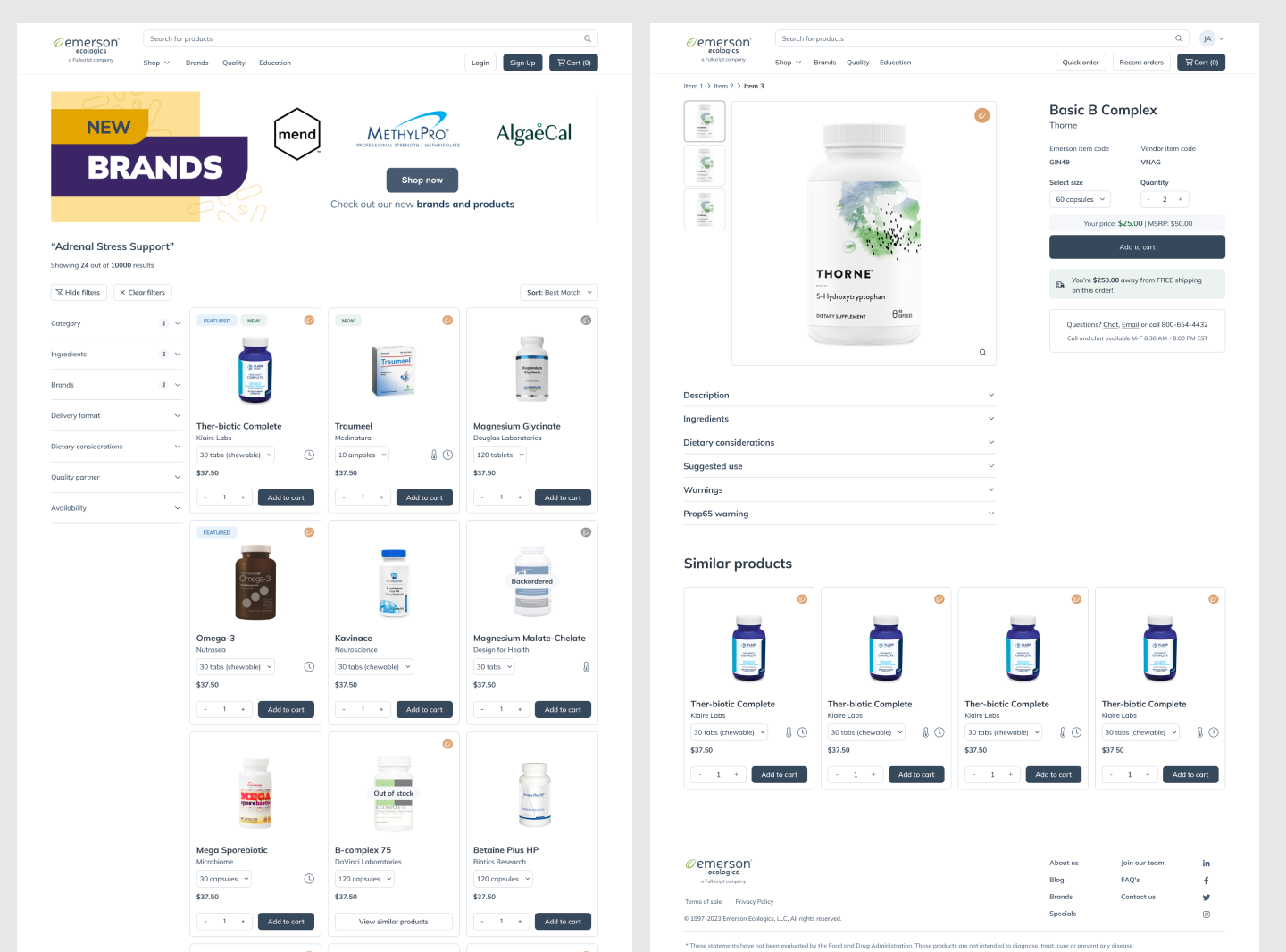
Because this was a ground-up redesign, I had the opportunity to revisit long-untouched areas of the Fullscript product as well. Improvements made for Emerson directly informed enhancements on both platforms, including Order History, Reorder flows, Account Settings, multi-image PDP, and Two-Factor Authentication.
Because this was a ground-up redesign, I had the opportunity to revisit long-untouched areas of the Fullscript product as well. Improvements made for Emerson directly informed enhancements on both platforms, including Order History, Reorder flows, Account Settings, multi-image PDP, and Two-Factor Authentication.
outcomes
A $220M business, replatformed without breaking
Emerson v2 launched to new sign-ups in mid-2024, with existing user migration scoped as the next phase to ensure continuity for the established base. The replatform consolidated EE onto Fullscript's tech stack eliminating redundant contracts and unifying engineering, customer success and catalog operations into shared tooling.
For the first time, EE had Mixpanel analytics and access to Fullscript's A/B testing infrastructure.
Strategically, the migration positioned EE to pursue its long-term goal: encouraging wholesale-only practitioners toward the Direct-to-Patient model, where each 1,000 converted accounts generates roughly $3M in additional gross margin.
reflection
Preserving trust is a design decision
As the sole designer on a team of 22 running 50+ projects over 14 months, the challenge wasn't just crafting good UI. It was maintaining quality, coherence and practitioner-centeredness across an enormous surface area, under real business pressure, without breaking a $220M revenue engine.
The biggest design lesson: the megamenu, the familiar catalog layout, the payment-on-ship behaviour. None were technically optimal from a Fullscript-standard perspective. But they were what EE users knew and relied on. Protecting them wasn't compromise; it was the right call for the mission.